Author Archives: catiefla

Peru – May 14, 2018 (Later in Day)

20180514_104823

After the bus ride back to Agua Calientes, we wandered around the shops and streets.  When we stopped for lunch, Mary Pat and I shared soup and salad but Rick, being very adventuresome, decided to order alpaca.  I think he really wanted to try guinea pig as that seems to be a major delicacy here in Peru—always by far the most expensive thing on the menu, as much as 100 soles.  We all decided that alpaca tastes like and has the consistency of beef.

20180514_143310.jpg

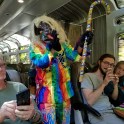
Then, on the train ride back to Ollantaytambo , we were treated to a fashion show of designs using alpaca wool but which started with a creature who danced through the car with several of the passengers.

20180514_171959

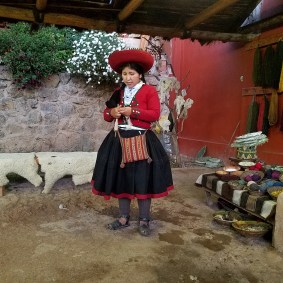
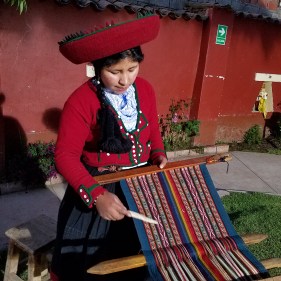
We were once again picked up in a private car for our drive back to Cusco.  Our driver, Omar, was very accommodating, stopping at several places for us to take pictures and we stopped at a local farm raising alpacas.  Not only did we get to feed them, we watched how the yarn is made, dyed using all-natural plants and herbs, then woven to create those lovely sweaters, jackets, coats, wraps, scarves, and more.  Of course, there was a store and, despite Mary Pat and I resisting our natural impulse to buy in every other location (there are stores galore in Cusco and Aguas Calientes), both of us broke down upon finding just what each of us wanted.  Baby alpaca is so incredibly soft, lightweight, yet warm at the same time.

20180514_173922                20180514_174523

Peru – Monday, May 14, 2018

Machu bus ride

Machu Picchu!  Considered a masterpiece of architecture and engineering, On July 7, 2007 Machu Picchu was declared one of the new seven wonders of the modern world in Lisbon, Portugal, which had the participation of one hundred million voters around the world.  Long on my bucket list, we met our guide, Jose Luis at 5:30 AM for the 30-minute bus ride, which was an adventure unto itself traversing a narrow, stone and dirt road carved out of the mountain with sharp switchbacks and no guardrails.  In July of 2017, due to the massive popularity of the site, new rules were implemented.  Entrance into the site is limited to 2,500 per day, split into two separate entrance times so tickets must be purchased in advance and you can only enter with an approved guide.

20180514_083041

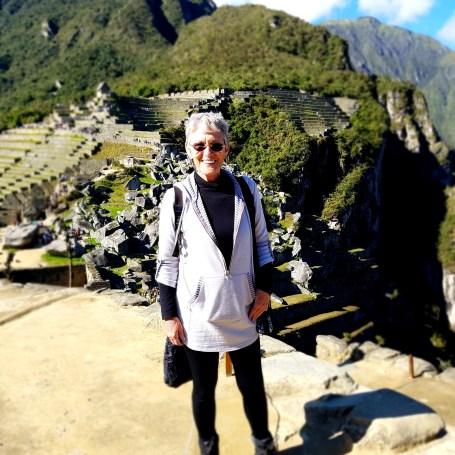
Me at the top

Some of the other rules… As set out in Article 19 of the Ministerial Resolution, here are the general visitor rules for Machu Picchu (I have only included the important ones):

  • 19.1. Any type of bag/rucksack measuring more than 40 x 35 x 20 cm (15.7 x 13.7 x 7.9”) is not permitted and must be placed in storage (near the entrance).
  • 19.2. It is prohibited to enter with food and drink.
  • 19.4. It is prohibited to enter with alcoholic beverages.
  • 19.5. It is prohibited to enter with umbrellas or sun shades (hats and ponchos / rain coats are permitted).
  • 19.6. It is prohibited to enter with photographic tripods or any type of camera stand/support. This is only permitted with pre-authorization and the appropriate permit.
  • 19.9. It is prohibited to enter with any musical instruments, including megaphones and speakers.
  • 19.11. It is prohibited to enter with shoes with high-heels, or hard soles. Only soft soles are permitted (like those found in training shoes or walking shoes/boots).
  • 19.12. It is prohibited to enter with children’s strollers / prams. Only strap on baby/child carriers are permitted.
  • 19.17. It is prohibited to climb or lean on walls or any part of the citadel.
  • 19.18. It is prohibited to touch, move or remove any lithic items / structures.
  • 19.22. It is prohibited to enter with walking sticks with a metal or hard point. Only elderly people and physically-handicapped people are permitted to enter with a walking stick, when it has a rubber tip.
  • 19.25. It is prohibited to get naked, dress up, lie down, run and jump.
  • 19.26. It is prohibited to make loud noises, applaud, shout, whistle and sing. The tranquility and character of Machu Picchu must be maintained at all times.
  • 19.27. It is prohibited to smoke or use an electronic cigarette.
  • 19.32. It is prohibited to feed the resident or wild animals.
  • 19.33. It is prohibited to paraglide, fly any type of drone or small aircraft.

Look at Rule 19.25!  Makes you wonder what people are thinking sometimes.

20180514_090838

Anyway, three different circuits are outlined and must be followed.  Our guide led us through Circuit 1, the classic route, the most challenging from a physical perspective as it takes in both the upper sector of the citadel before heading in a large loop to the lower sector.  It takes approximately 2-1/2 hours to complete.  There are additional trails up the Huayna Picchu Mountain (behind Machu Picchu) one can trek but we did not.


I cannot emphasize enough the awe I felt.  The citadel itself is thought to have been built starting in 1450.  Just imagine the primitive instruments, the architectural knowledge, the Incas used to build this massive structure that has lasted thus far over 550 years.  Almost more astonishing is the way they built “windows” to predict the seasons or the carved rock outcropping, in the foreground of the photograph below, which echoes the shape of the mountains beyond, directing the viewer’s vision out into the landscape while simultaneously bringing the power of a distant peak into the site at Machu Picchu, Peru.

20180514_074628      Machu 4

Some other views:

20180514_081342    20180514_075850    20180514_081318.jpg


Peru – Sunday, May 13, 2018

Up early to meet our tour guide for the next leg of the trip.  A nice gentleman from the local office serving Viator tour picked us up in a private car for the two-hour drive to Ollantaytambo.  The drive was magnificent through the upper portions of Cusco then through many small towns, traversing through the mountains down from almost 12,000 foot height of Cusco to a mere 9,353 feet.  In Cusco, we all had become a bit lightheaded with slight headaches but nothing serious.

Ride from train     Ride from train1.jpg    Ride from train 3

Ollantaytambo is a quaint little town of less than 10,000 studded with hostels, restaurants, and souvenir shops.  The train station was quite busy but we found that as first class passengers on the Vistadome, we were given access to free restrooms, a beautiful waiting area, and shops.  Rick, Mary Pat and I all bought sandwiches for the train before we boarded a beautiful car with comfortable leather seats and tables.  Large windows, including on the roof, afforded us views of some of the most magnificent scenery in the world.  Mary Pat and I, of course, snagged the window seats.  Shortly after departure, we were served complimentary coffee, tea, and a delectable carrot cake.  After this, Mary Pat and I enjoyed a local Peruvian sauvignon blanc, Intilpaca.  The ninety-minute ride took us through the scenic sacred valley to Agua Caliente where we had reserved a room for the night.

Agua

Since we arrived mid-afternoon, we set about exploring the town.  Agua Caliente is at an elevation of 6,690 feet, population of only 1,600 yet it seemed to be a bustling little metropolis as scores of tourists roamed the streets.  Shops selling alpaca sweaters and cover-ups, restaurants, and hotels seem to be the dominant industries.  We stayed at the comfortable Hotel Satay minutes from the train station.  All of us were in the mood for a good dinner and we were definitely gastronomically pleased.  Rick order a beautiful trout dish, Mary Pat ordered chicken, and I had rack of lamb.  We shared a bottle of wine and our total price was only about $50.00!

Trout     Chicken    Lamb


Peru – Saturday, May 12, 2018

Amazon Eco Lodge

We have been experiencing highs in the 90’s with humidity at about 95%.  Evenings temps have usually dropped to the mid-70’s.  We are staying in a beautiful cabin with many screened windows – no glass.  There is no heat or air conditioning and, with no electricity at night, no fans.  This made for some warm nights but last night we experienced a wicked thunderstorm when temperatures plummeted about 40 degrees.  For several hours, the skies opened and rain pounded the roof, winds whipped through trees and windows, angry bolts of lightning were immediately accompanied by booming thunder. Not much sleep.

Today we are scheduled to leave by boat at 8:00 am and I just prayed through the night that the storm would pass through so we didn’t have to experience riding in a canoe up river back to Puerto Maldonado.  My prayers were answered.  While it was a cold ride, it was dry.  We were dropped off at Puerto Maldonado airport which, when we arrived, was a rather sleepy place with little activity.  That wasn’t the case this morning as the airport was jammed with travelers seeking to fly either to Lima or Cusco.

Before leaving Puerto Maldonado, I have to talk about the scrumptious food served in ample quantity throughout this stay at Amazon Planet Lodge. Every meal included local dishes, homemade juices with fruits picked on the property, desserts made with local fruit or chocolate.  Service was superb–all in all a very enjoyable experience.

I also forgot to mention the incredible sight of the star-filled sky the night of the caiman search.  With so little ambient light in the Amazon rainforest, the sky is so clear and yet so bright.  For those who have never seen a truly dark sky, a true discovery awaits. You can actually see varying hues in the night sky.  It is magical.  I happen to know that you do not have to travel to the Amazon rainforest (although I recommend it to everyone) for dark sky gazing.  The International Dark-Sky Association has a page where you can enter our zip code to find the closest spot to you:  Dark Sky Finder.  I actually visited the Natural Bridges National Monument in Utah at night–it was the first international dark sky park certified by this organization.

Misters Inkas

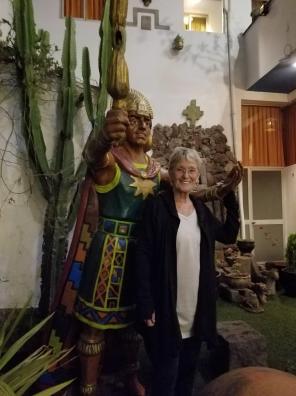
Me in Misters Inkas lobby

So, back to the trip:  We flew to Cusco without event and arrived at Misters Inkas Palace Hotel.  Temperatures here are quite a bit lower than in the jungle.  It is probably in the upper 60’s.  I know I mentioned before that Cusco is high in the Andes with an elevation of almost 11,200 feet.  Cusco is bustling with energy with cars, taxis, buses, motorcycles all vying for the right of way making it difficult for pedestrians but we found that the traffic police are SO nice.  We even had one stop traffic in the middle of a block to let us cross!

Anyway, we were on a mission.  I broke my glasses last night.  Not fixable.  I have a week to go and I do not see well without them.  I was told they don’t sell readers at pharmacies like they do in the US but rather at optometry shops and the desk at Misters Inkas told me there was an optometrist shop nearby so we set off to find it.

I had figured that I could buy readers since my distance visual impairment shouldn’t affect my walking around.   As we found so far throughout Peru, very few people actually speak English but thank God for Google Translate.  Through this app, I told the doctor what I needed and he disagreed.  He found a frame on his wall and said he could remove my actual lenses and put them in new frames within an hour!  Total cost 140 soles which translates to about $40.  We left, ate dinner (arroz con pollo which was excellent), went back and they fit perfectly!  What a godsend.

We retired early as in the morning we are off to our tour of Machu Picchu–LATER!

Peru – Friday, May 11, 2018

Canopy
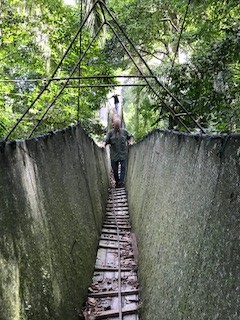
Monkeys frolicking in the trees outside with macaws squawking. Shortly after breakfast, we set off hiking into the jungle with the ultimate goal of climbing the canopy bridge. HIGHEST TREE PLATFORM IN SOUTH AMERICA! It is a 90 meter (295 feet) long walkway until you reach the platform at 45 meters (148 feet) high in the crown of an ancient Kapok tree. This was an athletic feat I am proud to say I accomplished. I have walked across other canopy bridges but never one that ascended to so great a height. Pictures do NOT do it justice. It sways continuously and, in several places, the “steps” (blocks of wood nailed to the bridge) were missing so my short little legs had trouble getting purchase. At the top, you crawl through a small opening in the platform where you are finally above the trees.

Canopy Me                  Canopy Rick and Me

The picture on the left is me descending the canopy bridge.  The one on the right shows Rick descending with me following the recommended 12 feet behind.  If I thought getting up to the top was difficult, I was in for a big surprise as the descent was the tough part…slippery and at times, the hand holds caused my arms to be completely extended. When I got to the bottom, my legs and arms were shaking so badly I almost collapsed.

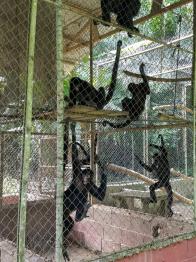
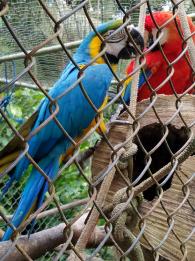
After this, we toured the animal preserve where they take care of injured monkeys, jungle cats (big and small), macaws, turtles, whatever animal they find who needs help:

Puma 1    Spider monkeys    Macaws

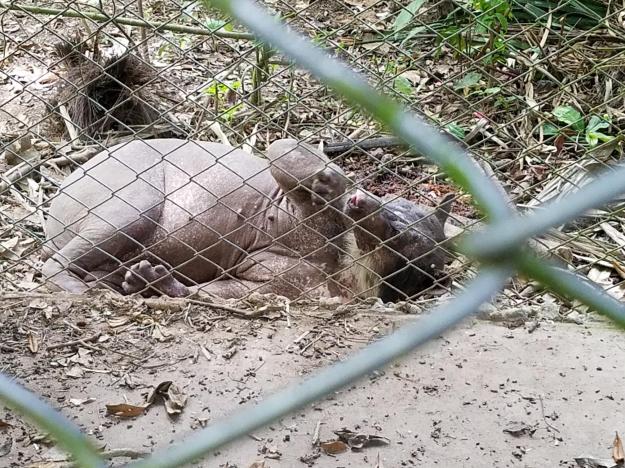
This organization does great work but probably the saddest case is Cholita.  She is spectacled bear, rescued by the Animal Defenders League in 2015.  Poached from the wild as a baby, Cholita was displayed and harrassed for a decade.  Her canines were ripped out and her front digits sawed off at the knuckles just so she couldn’t harm her handlers.  Bad diet, stress, and confinement led to a case of atopecia,  a condition in which hair is lost from some or all areas of the body.  Sen a circus wanted her.he suffered for another decade until not even a circus wanted her.

She was finally sent to Taricaya National Reserve and, after a year, she has gained weight, appears to be happy, and is apparently remembering how to be a bear.  Here is Cholita today:

Bear


Peru – Thursday, May 10, 2018

Mud hike 2Mud hike

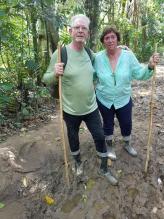
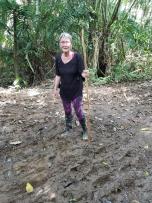
We met our guide, Alejandro, at 5:00 AM for our trip to Sandoval Lake. The lodge packed each of us a “snack” – apple, tangerine, crackers, breakfast bar, juice box, candy, bottled water, as well as two avocado, tomato, and sliced boiled eggs sandwiches. We each donned a pair of rubber boots, were issued a walking stick, and then rode up the river to Tambopata National Preserve where we hiked 6 K through the jungle. Over roots, through mud, balancing on narrow paths around trees using sticks to hold us upright, until we reached the swampy bayou where we transferred to canoes.

Caiman (2)
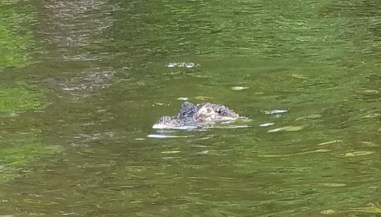
Sandoval Lake is full of caiman, electric eels, piranha, leeches, otters. We encountered many birds and butterflies and were quite excited when we rowed into this little inlet to see and hear a family of howler monkeys. We were excitedly snapping pictures when all of a sudden, Rick said “Caiman”. With that, Alejandro immediately said “ROW!”. This black caiman was charging us – I swear the look in his eyes was SCARY! We booked out of that inlet and, as soon as we did, the caiman backed off. This guy was huge. Alejandro said black caiman are extremely territorial and they have been known to charge boats, whipping their tails up into the boat. Phew!


Raft view

Our view from the raft

After the canoe ride, hiked back to the trail head and motor boated back to the lodge where lunch was waiting. After a couple of hours of downtime, our guide drove us up river a ways where mid-river, Rick, Mary Pat and I transferred into a rubber raft with paddles. They left us! While it seemed scary, it was actually very relaxing as the sun set while the current lazily carried the raft along. When we returned to the dock, we got into one of the lodge’s motorized craft for a caiman search after dark through the marshland off the river.

 
Dinner was a traditional Peruvian dish – Pachamanca, a traditional Andean dish dating back to the Incas that’s prepared using the earth as an oven. The meal is known as a pit roast and incorporates marinated meats wrapped in banana leaves and vegetables, such as potatoes, fava beans, and corn on the cob seasoned with fragrant herbs.  YUM!

Peru – Wednesday, May 9, 1980

I woke at about 4:00 AM hoping to see the sunrise from our cabin but a thick, misty fog enveloped the area, absolutely obliterating the river and its banks. So, I made myself a cup of coffee and laid back down to read until hearing my cabin-mates getting ready for the day. We walked around the property until the gong sounded at 7:30 AM signaling the serving of breakfast so we immediately made our way to the dining area.

TrogonMonkeys (2)
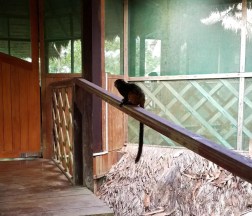
Approaching the dining room, several tamarind saddleback monkeys were scuttling in and out! Then, one of the most beautiful birds sat on a tree right outside our window—it is a trogon.
Breakfast was seasoned scrambled eggs, fresh cheese, mango and papaya, and absolutely divine, excellent coffee. After breakfast, Jean Pierre took Mary Pat and I on a tour of the property, showing us various trees and plants which help to self-sustain the lodge.
We were picked up by our tour operator at 10:30 AM only to experience the same bumpy ride but this time into the town. Puerto Maldonado, 34 miles from Bolivia, is located where the Madre de Dios and Tambopata rivers meet.  The Madre de Dios joins the Madeira River as a tributary of the Amazon.  We crossed the longest bridge in Peru across the Rio Madre de Dios.  Before the bridge was built in 2011, residents across the river had to boat over to Puerto Maldonado for shopping and other essential services.

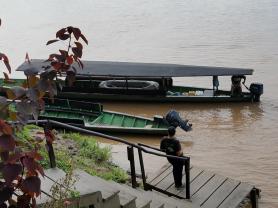
Canoe
Once all the tour participants had arrived, we were loaded onto a motorized canoe for the hour-long trip down the Madre de Dios River to the Amazon Planet lodge. We arrived just in time for lunch which was a scrumptious appetizer of tomatoes layered with fresh cheese, drizzled with a cilantro vinaigrette, the Peruvian version of chicken nuggets, rice and local vegetables.

 
We were told meals are at 7:30 AM, 1:00 PM, and 8:00 PM. Electricity is only available from 6:30 – 7:30 AM, 12:30 – 3:30 PM, and 5:30 – 10:00 PM. And, of course, there is no WIFI!
We were then shown to our rooms—a cabin overlooking the river. At 3:45 we met up with our guide for our first hike through the rainforest where he pointed out the various trees, vines, and plants. After less than five minutes or so, we were completely surrounded by the jungle with only the sounds of birds and monkeys. Other than nature, it is very quiet and peaceful here with the occasional motor-operated boat engine jarring the tranquility.
We were scheduled for a night hike at about 6:30 PM but instead, Rick, Mary Pat and I chose to attend the bar before dinner. Less than fifteen minutes into the hike, our fellow travelers abandoned the hike in favor of libation. Apparently, there was a swarm of flying cockroaches attacking them so even the guide was repulsed.
Dinner was Aji de Gallina–chicken, potatoes, and a curry-like sauce that gets its yellow color from aji Amarillo, a chili with a medium heat level. After dinner, some rousing games of jenga united this international group—England, Canada, New Zealand, Russia capped the day.

Peru – Tuesday, May 8, 2018

I traversed immigration and customs and then met up with Rick and Mary Pat in the Lima airport with only a short wait for our flight to Puerto Maldonado.  I expected some sort of rinky-dink airline as this flight is basically a commuter flight flown several times daily.  I was pleasantly surprised to see the roomy seats and especially that I got three to myself!  The flight is only a little more than an hour so, before we knew it, we were descending into the jungle onto a runway literally cut out of the dense rainforest.

After getting our checked bags, we were met by a guy holding a sign with our names and were loaded into a rather beat up van.  I guess the van was better than all the little three wheel taxis.  We embarked on this harrowing ride on a dirt road full of potholes that could swallow my VW Bug.  Even though the distance is a mere 5-1/2 miles, it took almost an hour!  We passed a huge shanty town which our driver told me contains squatters numbering two to three thousand.  Mangy dogs wander aimlessly, smoke wafts up through the air from fires in big metal cans.  As it is hot and humid, we were baffled as to the purpose of these fires.  When I asked why these people are there, I was told that it is a political thing.  They originally migrated from other parts of Peru seeking jobs mining gold in the Madre de Dios Region.

Shantytown

According to an article by Bill Weir of CNN,

“One autumn day in 2009, the price of gold topped $1,000 an ounce.  That nice, round number brought cheers on London trading floors and toasts in Manhattan bars, but it made a different noise in “Mother of God,” Peru.


Madre de Dios is a pristine chunk of the Amazon about the size of South Carolina, where macaws and monkeys, jaguars and butterflies thrive. It is some of the healthiest rainforest left on Earth and here, that $1000 number brought the sound of chain saws, diesel pumps and dirt bikes.
It created jungle boomtowns, complete with pop-up brothels and gun fights, as tens of thousands of men from the poorest corners of Peru joined a modern gold rush.  
Much like the ’49ers sluiced for treasure in California more than 150 years ago, these miners use primitive methods involving mercury. Most don’t fully understand that “quicksilver” is toxic to every form of life in the Amazon. Or that since they fish the same waters they mine, it can end up in their own bloodstream, causing a host of health problems.
 Sotupa

We finally arrived at Sotupa Eco House on the banks of the Rio Tambopata.  A gem located outside of Puerto Maldonado proper (a city of approximately 80,000), this lodge is family-owned and operated.  Jean Pierre (the son) runs the place, bartends, and is a very charismatic and knowledgeable inn keeper.  A cozy cabin overlooking the river was our home for the night.  Dinner was announced by a gong…local sausage, wild rice, and spices.

Drinks

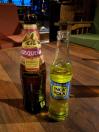
After dinner, we joined Jean Pierre at the bar where Mary Pat and I chose Cusquena (local beer) as our libation.  Rick drank a Inca Kola that, to me, was reminiscent of vanilla sodas they used to make at soda fountains back in the day.

On the way back to our cabin, a porcupine scuttled its way through the brush.  Meanwhile, chickens and roosters wander the property at will and many multi-colored birds serenade.


On my way to Peru – May 8, 2018

expatriate

This morning, at breakfast, I met two American expatriates now living in Panama.  One is a missionary who originally went to Panama to perfect her Spanish and stayed because she fell in love with the country.  The other, a gentleman traveled for business down to Panama often enough that he decided to relocate.  He is now retired and living the expat life.  According to these two, approximately 5,000 expats make their home in this country that welcomes new residents.  I’ve read posts saying as many as 20,000 Americans and Canadians make their home in Panama.

For a retiree, this means you don’t actually have to be retired to get it-you just have to be over 18. All you need to do is to prove you have a lifetime pension of at least $1000 per month.  If you buy $100,000 worth of property in Panama, then the minimum is just $750.  Others basics you’ll need for a visa are a police certificate from the town you most recently lived in  your country of origin, a health exam and an AIDS test.

At one point in my life, I actually considered this.  I think I was 60 and investigated both Panama and Belize as potential retirement destinations.  Instead, I went into Americorps for a year and somehow decided that I didn’t really want to leave America other than as a vacationer.

Anyway, after breakfast, I caught the shuttle to the airport.  I had several hours to kill so wandered around the shops and stopped for a con leche.  Several times I saw a young woman wearing a University of Pennsylvania t-shirt.  It caught my eye because I used to work and attend school there (many years ago).  I decided to sit and read for a bit so I went to my gate area and settled in.  It wasn’t but a few minutes when the U of P woman sat down across from me.  I had to ask her if she attended school there.

We spoke for the two hours until boarding exchanging stories.  Mariella is a citizen of Peru, grew up in Lima, told me the t-shirt was a gift from a friend but that she and her husband both attend Penn State in  programs to obtain their Master’s Degrees—hers in sociology and his in business.  Her sister is getting her Master’s in Wild Animal Management in Australia.  According to Mariella, most Peruvians vacation within their own country but many get their higher learning elsewhere.  Mariella and her husband intend to return to Peru when their studies are complete but she told me her sister plans to stay in Australia as she feels safer there than in Lima.

What a nice girl she was–right before boarding, I noticed the charge on my phone was at 38% and Mariella very graciously offered me her charger to use while on the plane.

south america

As is my usual habit, I immediately started reading after settling into my seat.  My seatmate commented to me he wished he had brought his Kindle.  We exchanged the usual pleasantries, inquiring as to each other’s reasons for the trip to Peru and for the entire three-hour flight, I abandoned reading and instead listened to some of the most fascinating stories.  Back in the early 80’s, Dom, born in Peru, wanted to attend college but spaces available at the university in Peru were given mostly to the privileged class.  He managed to get an invitation to attend a school in southern California but he said the US would not grant him a visa.  Dom told me that opportunities in Lima for impoverished youth were limited.  So, determined to lead a better life, at age 18, he embarked on a mission to get to California.  He took buses from Lima, Peru up through Ecuador, Colombia, Panama, Costa Rica, Nicaragua, and into Mexico.  I cannot even imagine!  To finance this trip, he had to work odd jobs along the way and he told me that it took him about three months. Once in Mexico, he again applied for a visa to get into the United States but was denied.

While in Mexico, he met some guys who told him they knew a place in Tijuana where they could cross.  He told me that not only was he successful that time but crossed back when learning of his mother’s death a year later so he traveled back to Peru to get his brother who he brought back with him to California, crossing illegally again into the United States.  He said he worked construction for various people in southern California and, in 1986, under President Reagan, amnesty was given to illegals.  Under this program, Dom applied for legal status.  He said the process was very long, starting with temporary residence, then permanent residence, and ultimately, citizenship.  In his recollection, the process took approximately ten years.  Dom proudly showed me his American passport.

He said he is a successful business owner in Riverside, California with a wife and two grown children.  We discussed the current conversation in America surrounding immigration and the wall.  Dom admitted to me that he is conflicted having entered the United States himself illegally.  His sons, he says, are staunchly in favor of the wall.  Interesting!

By the way, I have to mention Copa Airlines and how completely pleased I was with the flight, the seats, the plane, and the food!  We were served a fritata with creamed spinach, fresh watermelon and mango salad, strawberry yogurt, and some sort of tasty meat (although it was a mystery to me as to what it actually was).

Since the entire time I was in the jungle, internet and cell service were non-existent,  I am just now getting the internet in Cusco (it is now May 12th) so I will be posting blogs from the past several days…