

I woke this morning to a somewhat foggy, overcast-looking day and, once the time was 7:30 AM, I went outside and took pictures for the “mid-point” tide. Shortly thereafter, I went to breakfast in this adorable room where, on china, we were served waffles, sausage, bacon, fresh strawberries and melons, fresh juices and homemade breads with an assortment of jams.
I then went back to the room where I gathered my phone, Kindle, and Chloe and we sat by the Bay’s edge as we waited for the tide to come in.
I tried taking the low (yesterday at 4:14 PM), medium (this morning at 7:30 AM), and high tides (today at 10:54 AM) from approximately the same vantage point. While I think that I took awesome pictures, they don’t necessarily do the phenomenon justice as the tidal change at this time of year is approximately twenty feet in six hours. The pictures below are, from left to right, low tide, mid tide, high tide showing essentially the same direction.
Looking straight ahead… (The high tide photo shows the basin full of water but it is so calm that the cloud reflection almost diminishes the fact that it is water below my feet)


Looking left towards the wharf and marina…


Looking right towards Victoria Beach…


Located halfway between the equator and the north-pole on Canada’s stunning east coast, the Bay of Fundy is one of the seven wonders of North America. The highest tides on earth, the rarest whales in the world, semi-precious minerals and dinosaur fossils; all this convinced an international panel of experts in 2014 to choose the Bay of Fundy as one of the natural wonders of the world.
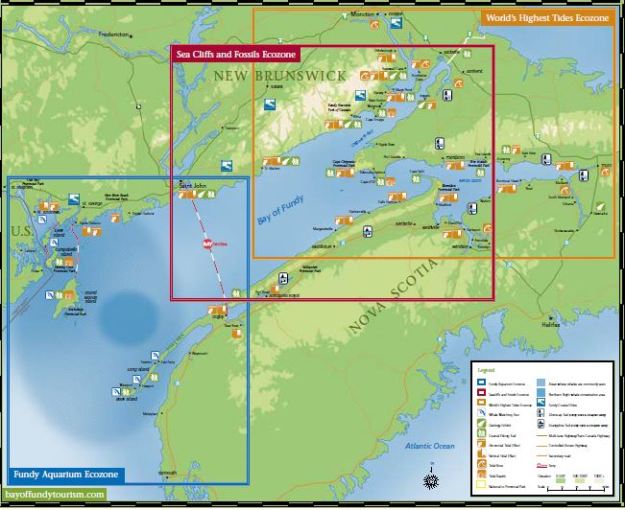
I was curious as to why this tidal change occurs so, did some research. As we all know, tides are the periodic rise and fall of the sea caused by the gravitational pull of the moon and the sun on the Earth. The explanation on the site, www.bayoffundytourism.com is one even I could understand:
“Fundy’s tides are the highest in the world because of an unusual combination of factors: resonance and the shape of the bay.
The water in the Bay of Fundy has a natural resonance or rocking motion called seiche. You could compare this to the movement of water in a bathtub. Although the water in a bathtub sloshes from one end to the other and back again in a few seconds, it takes about 13 hours for the water in the bay to rock from the mouth of the bay to the head of the bay and back again. As the ocean tide rises and floods into the bay every 12 hours and 25 minutes, it reinforces the rocking motion.
To imagine this, picture an adult giving a gentle push to a child on a swing. Just a very small push is required to keep the swing moving. Likewise, the seiche in the bay is sustained by the natural resonance of the ocean tides.
The bay’s shape and bottom topography are secondary factors contributing to Fundy’s high tides. The bay becomes narrower and shallower — from 130 m (426′) to 40 m (131′) — toward the upper bay, forcing the water higher up onto the shores.”
And, finally, I also found a fascinating time lapse photo of the Digby Marina during the tidal change. Click on the arrow to see the change…
 Meandering Catie
Very cool.
LikeLike
interesting
LikeLike
Amazing pictures!
LikeLike